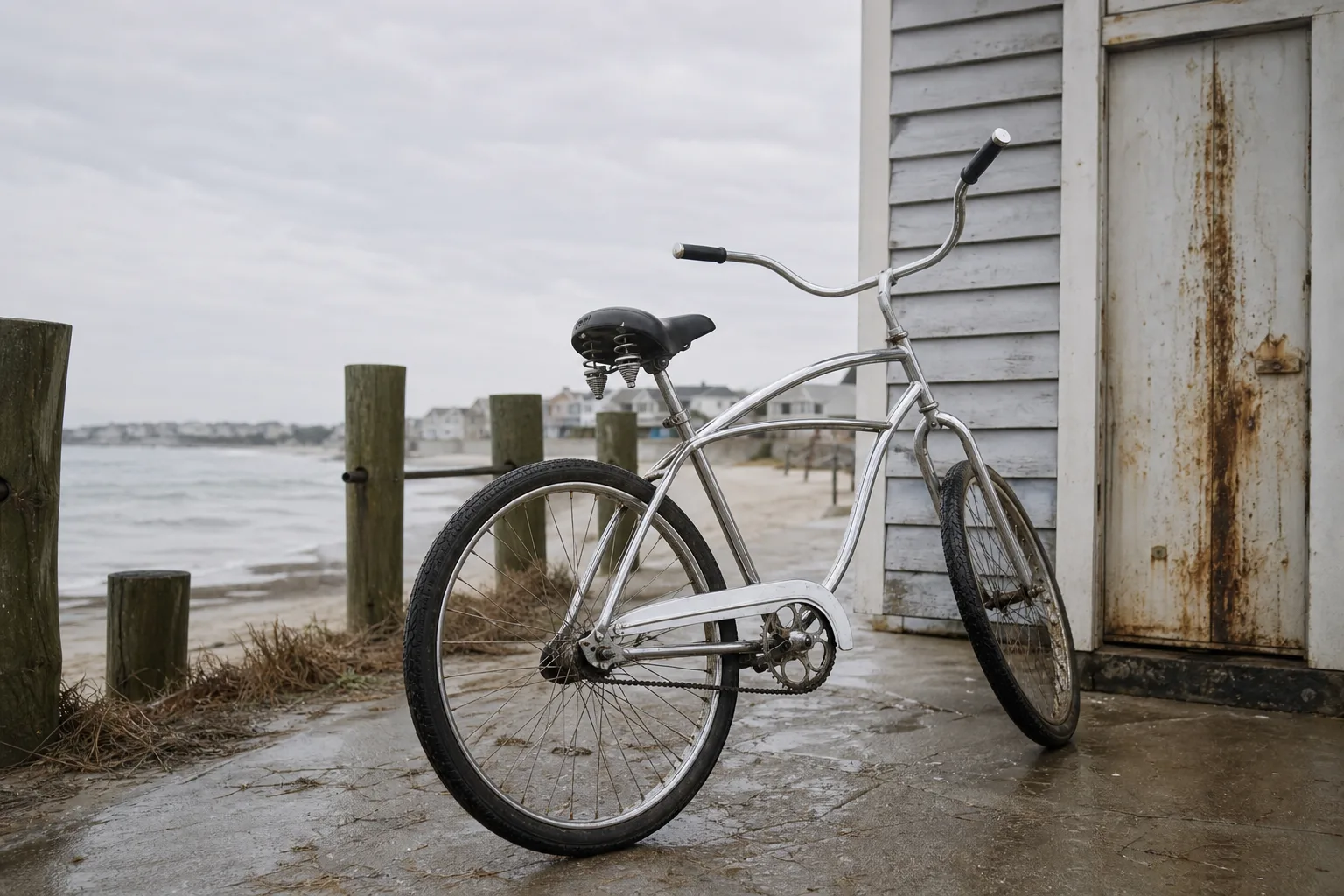
An upright, heavy, flat-bar bicycle suits some streets and punishes others. This is what one rider worked out after buying the wrong size and living near salt water.
Salt air does not attack a bicycle evenly. It works through the machine in a sequence, and the sequence is consistent enough that a rider two blocks from the water can predict, within a season or two, which part will stop working next. What confuses people is that the sequence has almost nothing to do with what looks worst. The parts that turn orange first are frequently the parts still doing their job three years later, while the components that fail are hidden, dry to the eye, and quietly filling with a paste of salt, grit and broken-down grease.
The order of failure, from weeks to years
The chain goes first, and it goes fast. A chain has hundreds of small steel bearing surfaces held together by a film of lubricant that salt-laden moisture displaces within days, and a bike left outside near an inlet can show surface rust on the rollers after a single humid weekend. Cables come second, usually inside the housing where nobody looks, which is why the first symptom is a rear brake that returns slowly rather than a visibly rusted wire. Bearings are third: the headset, the bottom bracket, the wheel hubs, in roughly that order because the headset sits highest and takes the most direct spray. Chrome rims and fenders are last, and often never.
That last point is worth sitting with, because it inverts the usual instinct. A chrome-plated steel rim develops brown speckling where the plating has microscopic pores, and it looks alarming, but the speckling is cosmetic until it starts lifting the plating in sheets. A chain with the same amount of visible rust has already lost measurable efficiency and is grinding its own rollers into a fine abrasive. The careful reader learns to distrust appearance and check function instead: does the chain flex sideways without resistance, do the cables snap back when released, do the hubs spin with a faint grinding note when the wheel is off the ground.
Rinsing, and what a rinse actually accomplishes
Fresh water removes chloride deposits before they hold moisture against bare metal, and that is the entire mechanism. It does not need pressure, and pressure is counterproductive because a hose nozzle drives salt water past the seals of exactly the bearings you are trying to protect. A slow flood from a watering can or a low-pressure hose, aimed at the frame and drivetrain and allowed to run off, does more good than a vigorous wash. The step people skip is drying and relubricating the chain afterward, which is the step that matters most, since a rinsed chain left wet is a chain you have just seeded with fresh oxygen. Ten minutes, weekly, beats an hour every quarter.
Which upgrades repay their cost
Stainless spokes are the clearest case. The price difference over plated carbon steel spokes on a rebuild is modest, the labor is identical, and the failure mode they prevent is genuinely expensive: a spoke that corrodes at the nipple seizes, and a seized nipple means the wheel cannot be trued without cutting it out and rebuilding. If you are buying new, ask what the spokes are before you ask about anything else on the wheel.
A sealed cartridge bottom bracket is the second clear case, and for a different reason. Loose-ball bottom brackets can be serviced, which is an argument for them inland, but servicing means opening the one bearing that is hardest to reach and most likely to be full of salt paste. A cartridge unit is a sealed consumable that you replace rather than maintain, and near the ocean, replacement on a schedule beats maintenance on hope. Sealed hubs follow the same logic. The National Institute of Standards and Technology is the federal body responsible for materials and measurement standards of this kind, and the general principle it works within holds here: a barrier that keeps the contaminant out beats a coating that resists it once it arrives.
What a careful reader checks before buying
Lift the bike and spin each wheel, listening rather than looking. Squeeze each brake lever ten times and watch whether the return slows. Pull the chain sideways at the front chainring. Then, and only then, look at the chrome, and treat what you see there as information about how the bike was stored rather than as a verdict on the bike itself. A cruiser with speckled rims and a clean, oiled chain has been ridden by somebody who understood the order.